

Architecture
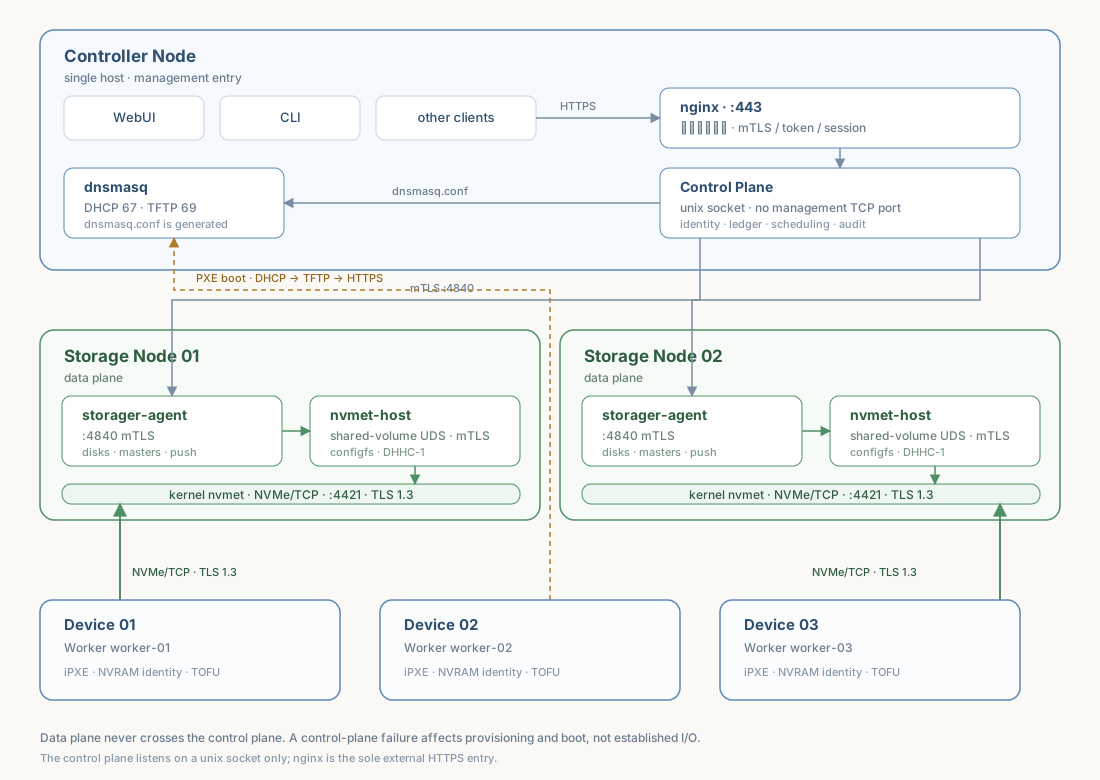
Kurrent consists of a control plane, storage nodes and devices. The control plane handles identity, ledgers, scheduling and configuration over HTTPS; the data plane carries block I/O between devices and storage nodes and never traverses the control plane.
Invariants
| Invariant | Meaning |
|---|---|
| Control/data separation | A control-plane outage affects provisioning and boots but not established data-plane I/O |
| Nodes hold no system state | System, identity and data come from the network; devices retain only a boot identity anchor |
| One authority per fact | Binding follows the device ledger, disks follow their NQN, declarations follow YAML; derived artifacts never write back |
| Deny by default | Management access is granted by declared principal classes; data-plane boot is refused when credentials or the port are not ready |
| Idempotent convergence | init / join can be rerun; failures roll back without half-applied state |
Components
- Control-plane service — Control-plane container, unix socket; Device/Worker ledgers, binding, storage scheduling, boot variables, audit, configuration status.
- nginx — Control-plane container,
:443; The only external entry: WebUI,/api/cp/, read-only boot endpoints, iPXE assets and menu. - dnsmasq — Control-plane host, host network; DHCP / TFTP;
dnsmasq.confis rendered from the declaration. - WebUI — nginx static assets; A REST client; session cookie or mTLS.
- CLI — Operator shell; Declaration generation, validation, convergence, credentials and ledgers.
- Agent — Storage node,
:4840mTLS; Disk-file lifecycle, master scanning, backend commands. - nvmet-host — Storage node, shared-volume UDS; configfs operations, host matrix, DHHC-1, TLS PSK injection.
- Host kernel nvmet — Storage-node host; NVMe/TCP target on data-plane port
4421. - Device firmware — Device; iPXE network boot, device key, TOFU, NVMe/TCP and NBCT.
Firmware is built from a separate repository; see Firmware.
Ports
Control-Plane Host
| Port | Protocol | Purpose |
|---|---|---|
| 53 | UDP/TCP | dnsmasq DNS |
| 67 / 69 | UDP | DHCP / TFTP |
| 80 | TCP | 301 redirect to 443 only |
| 443 | TCP | The only HTTPS entry |
| — | unix socket | Control-plane management plane; nginx and health checks |
The control plane has no TCP listener and does not mount docker.sock.
Storage Node
| Port | Protocol | Purpose |
|---|---|---|
| 4840 | TCP | Agent HTTPS (mTLS, called by the control plane) |
| 4421 | TCP | NVMe/TCP data plane, TLS 1.3 enforced; shared by firmware and kernel |
| — | Shared-volume UDS | nvmet-host management plane (mTLS) |
| 3260 | TCP | iSCSI compatibility backend (no live boot path on mainline) |
Device
A device only needs DHCP, TFTP, HTTPS and the storage-node data plane; it does not access the management plane directly.
Data Flow
Management Request
browser / CLI
  → 443 nginx
      → mTLS validation (users/nodes bundle + CRL)
      → identity headers injected (SUCCESS only)
  → unix socket control plane
      → authenticator chain (certificate / token / session)
      → principal classes and RBAC
      → ledgers / audit / Agent calls
Provisioning and Credentials
control plane
  → 4840 Agent (mTLS)
      → UDS nvmet-host (mTLS)
          → configfs: subsystem / namespace / port / allowed_hosts / dhchap_key
          → kernel .nvme keyring: TLS PSK
Push results are written back to the ledger; failures are retried by background reconciliation.
Boot
device
  → DHCP / TFTP (first hop)
  → HTTPS: scripts, device report, challenge, /boot-vars
  → 4421: NVMe/TCP + TLS 1.3, authentication and I/O
  → NBFT / NBCT → initramfs
The control plane participates only in the HTTPS segment; the data plane connects the device directly to the storage node.
State and Derived Artifacts
- Control-plane declaration —
control_plane/kurrent.yaml; Authoritative input. - Node declaration —
storager/kurrent.yaml; Authoritative input. - Devices, Workers, disks, credentials, sessions, tokens —
control_plane/state/*.yml; Runtime ledgers. - Audit —
control_plane/state/audit.jsonl; Append-only log. - PKI —
control_plane/state/pki/; Trust roots and component certificates. - TOFU server certificate —
control_plane/state/certs/; Boot-chain certificate and fingerprint. - dnsmasq configuration —
dnsmasq/dnsmasq.conf; Derived from the declaration; never edited by hand. - Boot scripts —
tftp/; Menu and scripts; firmware binaries come from the firmware repository.
There is no database. The control plane is a single node with plain-file state; state backup, permissions and single-node failure boundaries are the deployment's responsibility.
Failure Domains
| Failure | Impact |
|---|---|
| Control plane stops | New provisioning, new boots, configuration changes and audit stop; established NVMe/TCP I/O continues |
| nginx stops | Management and boot-chain HTTPS unavailable; data plane unaffected |
| dnsmasq stops | New devices cannot DHCP/TFTP boot; running systems unaffected |
| One storage node stops | Disks on that node cannot boot or lose I/O; other nodes unaffected |
| Control-plane host lost | Restore from backup; losing PKI/certificates forces components to re-enroll and devices to re-trust |
| Device lost | Rebind a new device; system disk and Worker identity remain |
Extension Points
- Storage backends: the Agent encapsulates nvmet / iSCSI differences; the control plane only speaks HTTP.
- Transport: the stateless semantics do not depend on a particular block protocol; replacing the transport does not change the entity model.
- Boot behaviour: menu, timeout and default disk are projected by the control plane and never written into the disk.
- Firmware: built from patches in a separate repository, reproducible on any upstream baseline.
Future directions (high availability, IPv6, ARM, data disks, Windows/ESXi) are in the Roadmap.
Further Reading
- Full repository architecture document: about/en/ARCHITECTURE.md
- Entities and binding: Devices, Workers and System Disks
- Boot sequence: Boot Chain
- Trust boundaries and threat model: Security Model
- Declarations and convergence: Declarative Configuration