

Architecture
Kurrent organizes physical devices, storage nodes and a control plane into a bootable, migratable compute system. Devices hold no persistent state: on power-up they complete identity verification over the network, receive a system disk and boot parameters, and boot with NVMe-oF as the root device; system disks are provided by storage nodes, and block I/O stays between the device and the storage node.
The system has three roles.
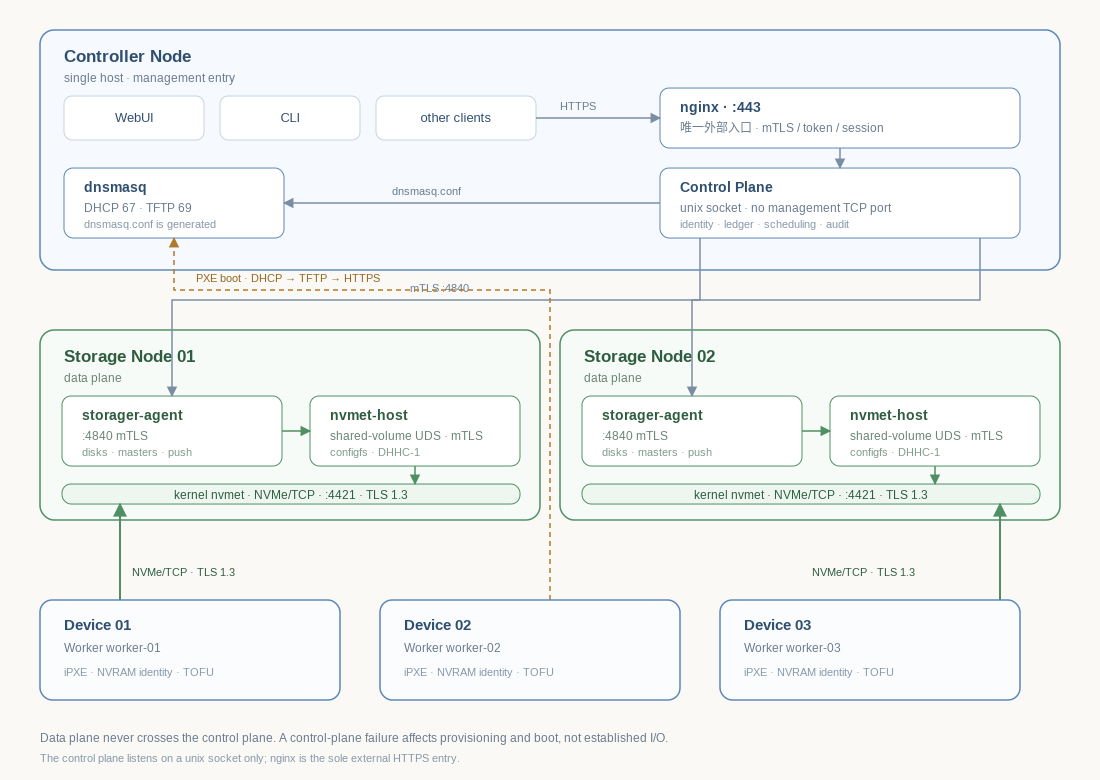
Control Plane and Data Plane
The system is split along one clean line: the control plane handles identity, scheduling and configuration over HTTPS; the data plane carries NVMe-oF block I/O and never touches the control plane. A Worker's disk traffic flows directly between the device and its Storager host (TCP 4421, TLS 1.3), so a control-plane outage degrades provisioning but never in-flight I/O. Every management operation converges on nginx 443, and the data plane does not depend on the control-plane process staying alive.
The Three Roles
Controller
The Controller is the brain of the cluster. The control-plane HTTP service listens only on an in-container unix socket; nginx exposes :443 as the management entry for the WebUI and management API. Signed firmware uses :4443 for boot HTTPS, which proxies only /boot-vars, /devices/report and /devices/challenge; :80 only redirects. dnsmasq runs on the host network and serves DHCP, TFTP and boot files. State is persisted as plain files (YAML / JSONL) in the state root outside the repository (control-plane/state/, control-plane/config/, control-plane/dnsmasq/); there is no database. The control-plane declaration is authoritative, and artifacts such as dnsmasq.conf are rendered from it at startup. The WebUI and CLI are just REST clients, and the state location is decoupled from the repository.
Storager
Storager is the block-storage side. Each node runs two components: the API Agent (:4840, mTLS) owns the disk-file lifecycle, master scanning and reflink cloning, and drives the local backend over HTTP; nvmet-host exposes an mTLS management plane only over a shared-volume UDS, translates commands into configfs operations, and injects TLS pre-shared keys into the kernel's global .nvme keyring. The data-plane port is 4421, with TLS 1.3 enforced and shared by the firmware and kernel segments. The backend of choice is nvmet; the iSCSI backend code is retained but has no live boot path on the main branch, and backend differences are encapsulated inside the Agent.
Devices
Devices are the stateless compute side. A physical device holds no persistent state: on PXE boot it reports its fingerprint (MAC / UUID / SMBIOS / CPU / memory / NIC — 11 fields) and is admitted into the device pool; after being bound to a Worker and given a system disk, it boots with NVMe-oF as its root device. Block I/O travels the data plane, never the control plane.
Three Entities
The role layer maps onto three objects: Device, Worker and System Disk. Disks are identified by NQN, with IQN derived from it; the binding is authoritative on the device side and projected onto the Worker. Unbinding or rebinding returns the device to the pool while the system disk stays with the Worker; a Worker may hold several system disks, and the default boot disk can be switched online. readiness is decided by both a bound device and a system disk.
| Entity | Identity | Notes |
|---|---|---|
| Device | MAC (unique) | Physical machine, ledger entry; the authoritative side of the binding |
| Worker | worker_id (== hostname) | Compute identity; a bound device becomes that Worker's booting node |
| System Disk | NQN | Storage volume (master clone or empty); multiple disks per Worker |
Data Flow
Management requests terminate at 443; provisioning is pushed from the control plane to storage nodes. Neither path uses the data-plane port.
Management Request
A management request reaches nginx first, which validates the certificate chain and CRL and injects identity headers only on SUCCESS; the request then crosses the unix socket into the control plane, which runs the authenticator chain, principal-class and RBAC checks, reads or writes ledgers, writes audit records and calls an Agent when needed. Identity headers are trusted only when injected by nginx; other proxied locations clear them.
browser / CLI
  → 443 nginx
      → mTLS validation (users/nodes bundle + CRL)
      → identity headers injected (SUCCESS only)
  → unix socket control plane
      → authenticator chain (certificate / token / session)
      → principal classes and RBAC
      → ledgers / audit / Agent calls
Provisioning and Credentials
Provisioning calls the Agent over 4840 mTLS; the Agent then calls nvmet-host over the UDS, which writes configfs and returns the result, while the TLS PSK goes into the kernel keyring. Disk creation issues the Worker-bound DHHC-1 credential at the same time; failed pushes are written back to the ledger and retried by background reconciliation.
control plane
  → 4840 Agent (mTLS)
      → UDS nvmet-host (mTLS)
          → configfs: subsystem / namespace / port / allowed_hosts / dhchap_key
          → kernel .nvme keyring: TLS PSK
Boot Chain
Boot starts with the DHCP and TFTP first hop: the device fetches iPXE and its pointer, then retrieves the configuration over HTTPS. Device identity is a non-exportable AK inside the TPM, which quotes PCR 0/2/4/7 on every boot; an unknown MAC enters the pool only while the registration window is open with a valid AK and Secure Boot enabled. /boot-vars checks the binding, quote signature, nonce and platform baseline in order, and only then projects root-path, NQN and credentials; the device connects with DH-HMAC-CHAP and encrypts with TLS 1.3. During sanboot the firmware installs the NBCT credential table, and initramfs consumes NBFT and NBCT to reconnect and mount the root filesystem — no machine identity is written into the disk.
device
  → DHCP / TFTP (first hop)
  → HTTPS: scripts, device report, challenge, /boot-vars
  → 4421: NVMe/TCP + TLS 1.3, authentication and I/O
  → NBFT / NBCT → initramfs
The control plane participates only in the HTTPS segment; the data plane connects the device directly to the storage node. Step-by-step detail is in Boot Chain.
Security Boundary
Management authentication tries three credentials in order — mTLS client certificate, management token and server-side session — and yields one Identity for principal-class and RBAC checks. Credential domains are split into three independent roots (users, nodes, control); nginx trusts only the users and nodes bundles, derives the principal class from the issuer, and every control-plane route declares the classes it accepts with deny-by-default. Every management request writes an audit record; if the write fails the request returns 503 (fail-closed).
Device identity rests on the TPM AK, single-use nonce PCR quotes, the platform baseline and binding-as-authentication; fingerprint reports grant no authority and only feed the device pool. Authentication and encryption are independent layers: DH-HMAC-CHAP answers who may connect, TLS 1.3 protects the content, and the PSK is a pure function of the authentication key with no plaintext fallback. The full threat model is in Security Model.
State and Derived Artifacts
The control-plane declaration and the node declaration are the only inputs; the former defines networking, PKI, the registration window and boot policy, while the latter defines the data directory, backend and NQN namespace. Runtime state lives under <state>, defaulting to ~/.local/state/kurrent and pinned by ~/.kurrent/deployment.yaml; ledgers, sessions, tokens, audit and PKI all live there, decoupled from the repository.
Trust material also lives under the state root: three root CAs (users, nodes, control) issue human, component and control-plane certificates; server certificates and CRLs serve nginx, while the boot chain is anchored by the boot CA embedded in the signed firmware; node identity, bootstrap credentials, component PKI and logs live under <state>/storager. On first deployment the management credential is handed to the deploying user through the one-shot exchange at <state>/control-plane/bootstrap; the bundle is deleted once consumed, while the authoritative admin.conf stays in the control-plane state directory.
Derived artifacts flow one way from authority: the dnsmasq configuration is rendered from spec.networking, the boot menu and default disk are projected by the control plane, and the WebUI and boot scripts are built from the repository. There is no database; the control plane is a single node with plain-file state, so state backup, file permissions and single-node failure boundaries are the deployment's responsibility. With state outside the repository, moving the checkout no longer affects ledgers or boot identities.
Ports
Ports are grouped by ownership to make the exposed surface explicit: the control-plane host offers 443 (management, 80 only redirects), 4443 (boot HTTPS) plus the DNS, DHCP and TFTP ports required for boot, while the management plane itself has no TCP listener; storage nodes expose 4840 and 4421, where 4840 accepts only control-plane mTLS and 4421 enforces TLS 1.3; devices need only DHCP, TFTP, HTTPS and the storage-node data plane.
Control-Plane Host
| Port | Protocol | Purpose |
|---|---|---|
| 53 | UDP/TCP | dnsmasq DNS |
| 67 / 69 | UDP | DHCP / TFTP |
| 80 | TCP | 301 redirect to 443 only |
| 443 | TCP | Management entry: WebUI, management API and unsigned debugging scripts |
| 4443 | TCP | Boot HTTPS: /boot-vars, /devices/report, /devices/challenge; boot segment only |
| — | unix socket | Control-plane management plane; nginx and health checks |
The control plane has no TCP listener and does not mount docker.sock.
Storage Node
| Port | Protocol | Purpose |
|---|---|---|
| 4840 | TCP | Agent HTTPS (mTLS, called by the control plane) |
| 4421 | TCP | NVMe/TCP data plane, TLS 1.3 enforced; shared by firmware and kernel |
| — | Shared-volume UDS | nvmet-host management plane (mTLS) |
| 3260 | TCP | iSCSI compatibility backend (no live boot path on mainline) |
Device
A device only needs DHCP, TFTP, HTTPS and the storage-node data plane; it does not access the management plane directly.
Failure Domains
Failure impact follows process ownership: a stopped control plane, nginx or dnsmasq affects only new provisioning, the management plane and booting, never established data-plane I/O; a single storage node going down affects only the disks on that node; losing the control-plane host requires a restore from backup, and losing PKI or server certificates forces components to re-enroll and devices to re-trust; a lost device is recovered by rebinding, while the Worker identity and its system disks remain.
| Failure | Impact |
|---|---|
| Control plane stops | New provisioning, new boots, configuration changes and audit stop; established NVMe/TCP I/O continues |
| nginx stops | Management and boot-chain HTTPS unavailable; data plane unaffected |
| dnsmasq stops | New devices cannot DHCP/TFTP boot; running systems unaffected |
| One storage node stops | Disks on that node cannot boot or lose I/O; other nodes unaffected |
| Control-plane host lost | Restore from backup; losing PKI/certificates forces components to re-enroll and devices to re-trust |
| Device lost | Rebind a new device; system disk and Worker identity remain |
Protocol Evolution
The data plane has moved from iSCSI to NVMe-oF (NVMe/TCP). The firmware main branch carries the complete patch set (0001–0011), and cold boot has been verified on several distributions. The semantics — stateless compute, disk/machine decoupling and an identity chain from MAC to boot — do not depend on a particular protocol: the Storager backend is abstracted by the Agent, so replacing the transport does not touch the architecture. iSCSI has no live boot path on the main branch; its historical implementation lives in the iscsi-classic branch.
Extension Points
Storage backend differences are encapsulated inside the Agent, and the control plane only speaks HTTP; the boot menu, timeout and default disk are projected by the control plane and never written into the disk; firmware is built from patches in a separate repository and can be rebuilt on any upstream baseline. Future directions (high availability, IPv6, ARM, data disks) are in the Roadmap.
The current architecture is a trade-off under today's constraints and will keep changing as they do. The goal is to decouple compute, storage and identity from individual machines so the system as a whole can be scheduled, migrated and rebuilt; the present components, protocols and deployment model are one way to get there.
What's next
- Entities and binding: Devices, Workers and System Disks
- Boot sequence: Boot Chain
- Trust boundaries and threat model: Security Model
- Declarations and convergence: Declarative Configuration