

Firmware Overview
Firmware is the layer that runs before the operating system. It extends UEFI's network capability into a verifiable, authenticatable NVMe/TCP boot path and proves the device identity before handing the connection to the kernel.
Firmware is built from the separate kurrent-firmware repository, and its artifacts are the first link in the main repository's boot chain. It is built from a pinned upstream iPXE baseline plus this project's patch set and embedded content, so protocol capabilities and the control plane can be released on their own schedules.
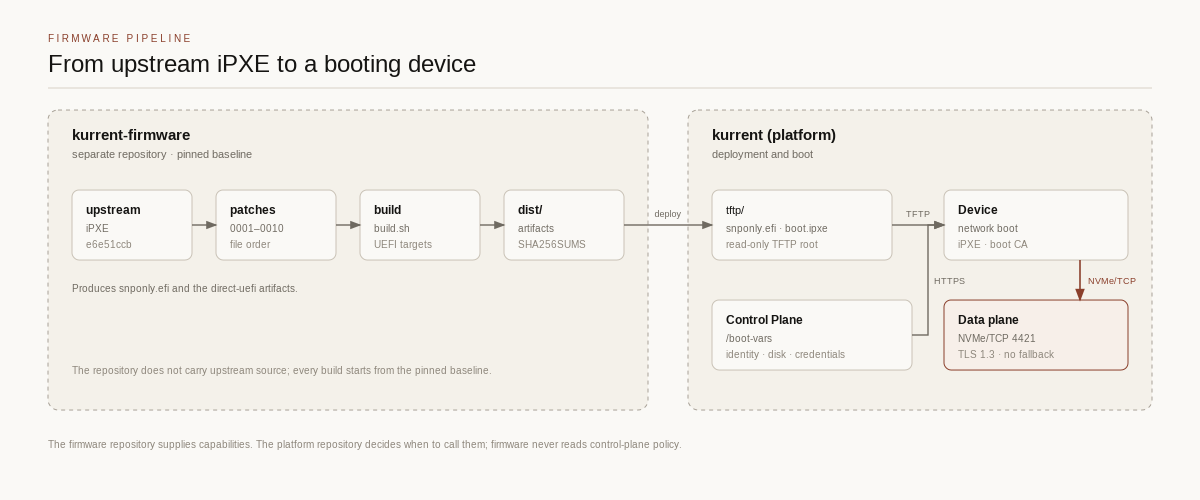
Firmware During Boot
In one boot, firmware performs network boot, identity attestation, trusted connection and hand-over in sequence.
Network and Scripts
Firmware loads the NIC driver, performs DHCP to obtain an address and next-server, fetches the boot pointer over TFTP, and then fetches boot scripts and variables from the control plane on port 4443. Signed artifacts trust only the boot CA embedded at build time and never first-contact trust; the first-stage binary itself is verified by UEFI db.
Device Identity
Device identity is a TPM 2.0 attestation key (AK). On first boot firmware creates a restricted signing key inside the TPM and persists it to TPM NV; the private key is non-exportable, and later boots reuse the same AK to produce a quote over PCR 0/2/4/7. The control plane verifies the signature and compares the platform baseline, and only then issues credentials to the device.
Data-Plane Connection
Firmware includes a native nvmetcp driver and connects to the target hosting the system disk over NVMe/TCP: ICReq/ICResp negotiation, Admin queue Connect, DH-HMAC-CHAP authentication, controller enable, Identify, I/O queue establishment, then block I/O. After authentication, sanboot establishes TLS 1.3 from the PSK issued by the control plane, so the firmware segment and the kernel segment are encrypted end to end on the same port.
Hand-over to the Kernel
Once connected, firmware writes credentials and discovery information into NBCT, and the kernel reconnects to the data plane during initramfs and mounts the root filesystem. Firmware does not generate an NBFT table; the verified chain injects that table to emulate the hand-over stage.
The complete trust prerequisites, failure behavior and per-segment connections are in Boot Chain.
Split with the Control Plane
Firmware owns protocol drivers, authentication, device identity commands and trust anchor pinning. The registration window, Worker binding, system-disk selection and credential issuance belong to the control plane: on every boot the device states only what it can prove, and the control plane decides whether it joins the pool and which disk it receives.
The boot script the device sees is generated by the control plane; when attestation fails the device receives an empty script, and the reason code goes to the audit log and the device record. The verification order on both sides is in Device Identity.
Firmware Status
The control plane aggregates firmware status at /api/cp/boot-assets: the first-stage file and its capabilities, reachability of the second-stage scripts, the menu, the Secure Boot artifacts and the data-plane port. The WebUI "Boot Chain" page shows the same results and reports, item by item, whether the platform can boot right now: firmware, service, data plane, Workers and reports.
firmware.status of incomplete usually means the TFTP root holds upstream iPXE rather than this project's artifact. When secureboot.status is not ok, check image hash, port and boot CA separately.
Operating Boundaries
- UEFI and NVMe/TCP only; no Legacy/CSM form, and no RDMA or FC.
- The boot path is single-controller and single-namespace; Identify parses both 512 B and 4 KB blocks.
- DH-HMAC-CHAP is one-way; mutual authentication is out of scope.
- Boot HTTPS uses iPXE native TLS, up to TLS 1.2; the data plane uses TLS 1.3 PSK, and the two are independent.
- Unsigned artifacts are for local debugging only; Secure Boot targets refuse to load them, and they do not satisfy the device pool admission requirements.
In This Chapter
- What baselines, patches and embedded content firmware consists of: Firmware Composition
- What the first stage, boot HTTPS and device identity each trust: Boot Trust
- Build and sign from the upstream baseline: Build
- Put the artifact on a PXE segment or local media and complete the first boot: Deployment and Provisioning
- Provision the target trust store and deliver the signed artifact: Secure Boot Provisioning
- Patch set, NIC matrix and target configuration: Firmware Platform Reference
- Commands and variables between firmware and the main repository: Firmware Contract
- Distribution scripts and family differences: Distribution Matrix
What's next
- Boot Chain
- Security Model
- Firmware sources, patches and research notes: https://github.com/dutyc/kurrent-firmware